From Hotel Raids to Roadblocks: The Day Democracy Was Held Hostage in Homa Bay
The crocodile statue appeared at 8 p.m. on Saturday.
A group of young men dragged it onto the Homa Bay-Rongo Road—a symbol of something darker unfolding in the lakeside town .
By Sunday morning, Homa Bay was a ghost town.
Shops shuttered. Streets deserted. Business paralyzed. The only movement came from armed groups roaming the roads, placing boulders and burning tyres to seal off entry points .
This was not a protest. This was a siege.
The Hunt Begins
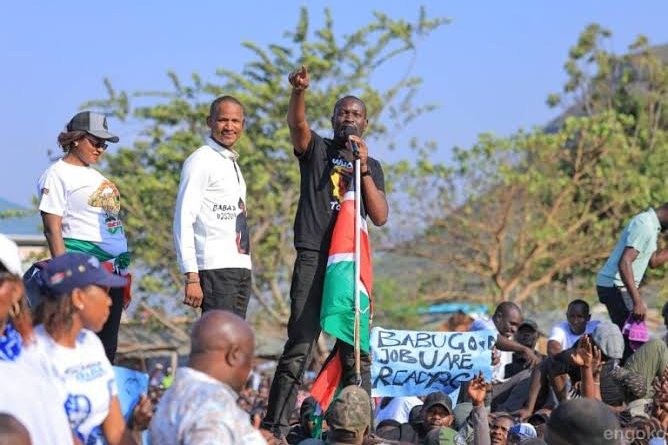
The Linda Mwananchi movement had announced a rally. Nairobi Senator Edwin Sifuna, Siaya Governor James Orengo, Embakasi East MP Babu Owino, and other leaders were expected. They planned to speak.
Someone decided that speech itself would not be permitted.
At 1:30 p.m. on Saturday, about 50 youths stormed the Homa Bay Tourist Hotel demanding to know if Linda Mwananchi members were staying there .
They weren’t.
The youths left—but returned at 4 p.m. This time, about 100 of them came armed with crude weapons .
They chased away guests and workers. They broke into every room. They destroyed CCTV cameras. They looted property. They switched off all the lights .
“They broke into each and every room looking for guests and looted everything from them,” hotel manager Otieno Odongo told the Nation .
The value of damaged and stolen property had not been established by Sunday morning. No arrests had been made .
The Video That Changed Everything
A viral video emerged. In it, Homa Bay Town MP Peter Kaluma was heard issuing instructions .
“I am ordering that from this moment, let’s go out and conduct a door-to-door search in all places of accommodation and get them out. I am also warning hotel owners here in Homa Bay Town to be careful of who they are hosting tonight. We shall cross with that guest and, if need be, even the hotel” .
Kaluma went further, telling a crowd: “As from today, we are declaring that anyone saying ‘One Term,’ we shall cross with him. If you know that you are a Gachagua sympathiser, please disappear” .
He announced he had provided fuel money to ferry people to search hotels for political competitors .
Witnesses described a scene that looked less like political mobilization and more like an organized manhunt.
Sunday: Democracy Died a Little
By Sunday morning, roads leading into Homa Bay Town were completely blocked. Large stones were placed across sections of the roads overnight. Tyres were set ablaze. Footage recorded at approximately 7 a.m. showed impassable roads .
The Linda Mwananchi convoy attempted to enter through the Suneka-Rangwe road but was forced to detour. Before reaching Ndhiwa, they encountered groups that had barricaded the road .
Police fired tear gas to disperse the crowds .
At Nyandiwa, violence erupted. Youths tried to block the leaders from holding a rally and attacked the convoy with stones. Police fired tear gas again .
Some attackers shouted “Tutam” in support of President William Ruto’s re-election .
By the end of the day, police had arrested 14 suspects—10 in Nyandiwa, four in Oyugis—and confiscated weapons including pangas, knives, and a sword . Two of the suspects were arrested near Wiobiero High School along the Sori-Rodi Kopany road. Police seized five pangas allegedly intended for violence .
The Attack on Truth
Two journalists arrived to cover the story. They became part of it.
AFP’s Fred Ooko and Brian Ongoro boarded a matatu from Kisumu at 6 a.m. They arrived in Homa Bay Town two hours later to find the town largely deserted .
As they searched for a motorbike to move around, they encountered armed youths who had barricaded the Homa Bay-Kendu Bay road .
“I was dragged on the road as goons beat me with clubs. My colleague Brian Ongoro was also beaten. He lost his phone and camera. My licence, press card and other assorted items were taken,” Ooko told the Nation .
A boda boda rider who knew Ooko intervened and helped him escape to Olare .
Ongoro, who had lost his phone, was assisted by Nation Media Group journalist George Odiwuor and taken to a police station .
The attack was not isolated. Other journalists from Nation Media Group traveling with the convoy were also waylaid. Their vehicle was pelted with stones. Another vehicle was torched by goons .
The Kenya Editors Guild responded with outrage.
“These are not scenes that belong in a constitutional democracy. They are acts of intimidation intended to instill fear and silence journalists performing a legitimate public duty,” Guild President Zubeidah Kananu said .
She called on Inspector-General of Police Douglas Kanja to ensure the incidents are independently and transparently investigated .
The Pattern We Cannot Ignore
This was not an isolated incident.
The Law Society of Kenya, East Africa Law Society, FIDA-Kenya, and ICJ Kenya jointly raised alarm over what they described as escalating political violence, hate speech, and intimidation ahead of the 2027 elections .
They cited recent incidents pointing to a worrying trend:
- The violent disruption of a civic forum at All Saints Cathedral in Nairobi on June 12
- The attempted attack on St Stephen’s Cathedral in Kisumu on July 12
- Fatal violence in Keumbu on July 3, leaving one person dead
- Alleged intimidation and violence against voters during the Ol Kalou by-election on July 16
- Reported threats of violence ahead of the Homa Bay rally
The lawyers warned that failure to address these incidents decisively could normalise violence and intimidation as instruments of political competition .
The National Council of Churches of Kenya (NCCK) echoed these concerns, warning that Kenya risks sliding toward a state where criminal gangs wield huge influence. They documented more than 30 incidents involving alleged goons since the beginning of the year .
The Voices We Must Hear
James Orengo, Siaya Governor:
“The people are with us, but these goons have been organised. This is not the Kenya we want” .
George Morara, Executive Director, Amnesty International Kenya:
“Any failure by public authorities to prevent or respond effectively to foreseeable violence undermines public confidence in the rule of law and weakens democratic institutions” .
Amnesty called for prompt, independent, impartial, and transparent investigations into all reported incidents .
Njeri Maina, Kirinyaga Woman Representative:
“Let me tell the NCIC chair, who is a bishop: do what you are supposed to do. Peter Kaluma should have been arrested by the DCI by now and presented before a court” .
SUPKEM Secretary Abdul Masud:
“Let our politicians stop barring their opponents from touring their strongholds. They should know that they will also go to their opponents’ strongholds to seek votes” .
The Question We Must Ask
A political rally should not require armed police escorts. Journalists should not fear for their lives while doing their jobs. Hotels should not be looted because of who they may or may not be hosting.
Kenya has a choice.
We can continue down this path—where political rallies become battlegrounds, journalists become targets, and democracy becomes a siege.
Or we can draw a line.
The legal organizations have issued a clear warning: failure to act now could normalise violence and intimidation before the 2027 General Election .
On Friday, police announced the arrest of 15 suspected gang members in Kisumu allegedly hired to disrupt political activities . In Homa Bay, 14 more were arrested . But no arrests have been made in connection with the hotel raid. The perpetrators of the journalist attacks remain at large.
If impunity continues, Homa Bay will not be the last place where democracy is held hostage.
The next political rally could be in your town.
And the next journalists attacked could be covering your story.
📌 What’s your take? Should political leaders be held accountable for inciting violence through public statements? Drop your thoughts below.
Sources: Amnesty International Kenya, Daily Nation, Kenya Editors Guild, Law Society of Kenya, Nairobi News, NCCK, The Standard, The Star, Tuko