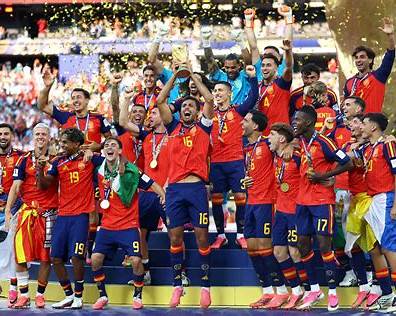
Spain Won the World Cup. Argentina Lost Its Throne. Football Has Entered a New Era
For a long time, Argentina had been the team everyone had to beat.
They were the reigning world champions. They carried the confidence of a nation that had already climbed football’s highest mountain. They had the history, the aura and the belief that when the biggest game arrived, Argentina would somehow find a way.
On Sunday night, that belief finally met its successor.
Spain defeated Argentina 1–0 after extra time in the 2026 FIFA World Cup final at New York New Jersey Stadium, with substitute Ferran Torres scoring the decisive goal in the 106th minute. The victory gave Spain its second men’s World Cup title and ended Argentina’s reign as world champions.
But this was not simply a final decided by one goal.
It felt like football turning a page.
The goal that ended an era
For more than 100 minutes, Argentina survived.
Spain had controlled much of the match but repeatedly found Emiliano Martínez standing between them and history. The final appeared to be moving towards the kind of tense, nerveless conclusion that Argentina had become so comfortable navigating.
Then came the moment.
Nico Williams headed down a cross from Pedro Porro. Ferran Torres arrived at the right time and finished first-time into the roof of the net.
One touch.
One finish.
One World Cup.
And suddenly, Argentina were no longer the champions.
Spain did not simply win. They announced themselves
There is a difference between winning a tournament and establishing an era.
Spain’s victory suggests the latter may be beginning.
Their triumph was built around control, technical quality and the ability to dictate the rhythm of the biggest games. Their midfield was led by Rodri, who was named the tournament’s best player after an outstanding campaign.
Spain’s victory also places them among the game’s elite nations once again. The title is their second men’s World Cup, and the win further strengthens the country’s position as one of the defining football powers of the modern era.
The message from Spain is clear:
The future of international football may belong to them.
Argentina’s defeat is bigger than the scoreline
This is the uncomfortable part of football.
A champion can remain brilliant and still lose its crown.
Argentina did not suddenly become a bad team. They simply encountered a Spain side that appeared ready to inherit the throne.
That is what makes this defeat so significant.
Argentina entered the final as the defending world champions. Spain entered it as the challenger. By the final whistle, the hierarchy had changed.
And football has always been ruthless about one thing:
Nobody owns the throne forever.
The World Cup has moved on
The final will inevitably be discussed through the lens of Lionel Messi and Argentina’s extraordinary recent history.
But the most important story may be what comes next.
Spain now have the trophy. Rodri has the Golden Ball. Ferran Torres has the goal that will be replayed for years. And a new generation of Spanish players now has something far more valuable than potential:
a World Cup medal.
Meanwhile, Argentina must begin the difficult process every champion eventually faces — rebuilding, rethinking and preparing for life without the certainty that came with being the team everyone feared.
That is the brutal beauty of football.
Yesterday’s champions can become today’s challengers in 120 minutes.
The final verdict
Spain did not win the 2026 World Cup through a moment of luck alone.
They spent the tournament building towards this moment.
And when the final finally reached its most decisive point, they found the player, the pass and the finish that Argentina could not stop.
Ferran Torres scored the goal. Spain claimed the trophy. Argentina lost its crown.
The World Cup is over.
But the next era of international football may have just begun.